

For most of online gambling’s history, payments were an afterthought. Players deposited by card or bank transfer, waited for withdrawals to clear, and accepted the fees and delays as part of the deal. There was no real alternative so there was no real pressure to change.
That has shifted. Cryptocurrency has moved from a niche interest to a mainstream payment method for a significant and growing segment of online players. And as more players arrive at casinos already holding crypto, already comfortable with how it works, and already expecting the speed it delivers — the platforms that were built around fiat banking are starting to feel the gap.
ZunaBet launched in 2026 with crypto payments at the centre of its infrastructure rather than bolted on as an afterthought. This article looks at why crypto payments matter to players, what the practical differences are, and how ZunaBet has built around those realities.
What Is Actually Wrong With Traditional Payment Systems
The problems with fiat payment infrastructure in online gambling are not dramatic. No single issue is a dealbreaker on its own. But they add up, and for players who have experienced the alternative, they become increasingly hard to accept.
Withdrawal times are the most visible issue. Bank transfers take two to five business days in most cases. Card payouts can take a similar amount of time depending on the issuing bank. E-wallets like PayPal or Skrill are faster but still involve processing layers that introduce delays. A player who finishes a session on a Friday evening and requests a withdrawal may not see the money until the following week. That is not a technical limitation anymore — it is a choice built into fiat infrastructure.
Fees are the less visible but equally frustrating issue. Card deposits can trigger cash advance fees from issuing banks, entirely outside the casino’s control. E-wallet transactions carry their own percentage charges. Bank transfers in some regions carry flat fees regardless of amount. None of this is unique to gambling — it is how fiat banking works — but it chips away at the value players receive.
Geographic restrictions add another layer. Players in certain countries find their cards declined, their e-wallets unsupported, or their bank transfers blocked by institutions that flag gambling transactions. The payment method a player uses comfortably for everything else in their life suddenly stops working when they try to fund a casino account.
Currency conversion is a related problem for international players. Depositing in one currency, playing in another, withdrawing in a third — each conversion step involves a rate and often a fee. For players outside the platform’s primary currency, the losses before a single bet is placed can be meaningful.
What Crypto Changes
Cryptocurrency does not solve every problem in online gambling. But it addresses the specific friction points that fiat banking creates — directly and structurally rather than through workarounds.
Withdrawal speed is the most immediate difference. A crypto transaction, when handled natively by the platform, settles in minutes. There is no bank processing the transfer, no card issuer holding the funds, no e-wallet sitting as an intermediary. The money moves when the transaction is confirmed on the network. For most major cryptocurrencies that confirmation comes fast. Players get their winnings when the session ends.
Fees drop significantly. Crypto network fees exist but are typically small and transparent — the player knows exactly what they are paying before the transaction is sent. There are no hidden charges applied by intermediary institutions. A platform that charges no processing fees of its own means the player keeps more of what they withdraw.

Geographic flexibility opens up. Cryptocurrency does not care which country the player is in or what their bank’s policy on gambling transactions is. A player whose card is declined has another path. A player in a region underserved by traditional payment networks can fund and withdraw without navigating restrictions that have nothing to do with whether gambling is legal in their jurisdiction.
Multi-coin support matters more than it might seem. Players hold different cryptocurrencies for different reasons — some hold Bitcoin as a store of value, others use Ethereum or Solana regularly for transactions, others hold stablecoins like USDT to avoid volatility. A platform that supports only one or two coins is asking players to convert their holdings before they can play. A platform that supports twenty or more meets players where they already are.
ZunaBet’s Crypto Infrastructure
ZunaBet was built from launch with crypto as its primary payment layer. It supports more than 20 cryptocurrencies including BTC, ETH, USDT across multiple chains, SOL, DOGE, ADA, XRP, and others. There are no platform processing fees on transactions. Withdrawals move at the speed crypto is designed to move at — not at the speed a banking intermediary allows.
That breadth of support is meaningful in practical terms. A player holding Solana does not need to convert to Bitcoin before depositing. A player who prefers USDT for its price stability can use it directly across multiple chains. A player who holds ADA or XRP has the same access as a player holding the most mainstream coins. The platform does not force players into a single crypto option and call it crypto support.
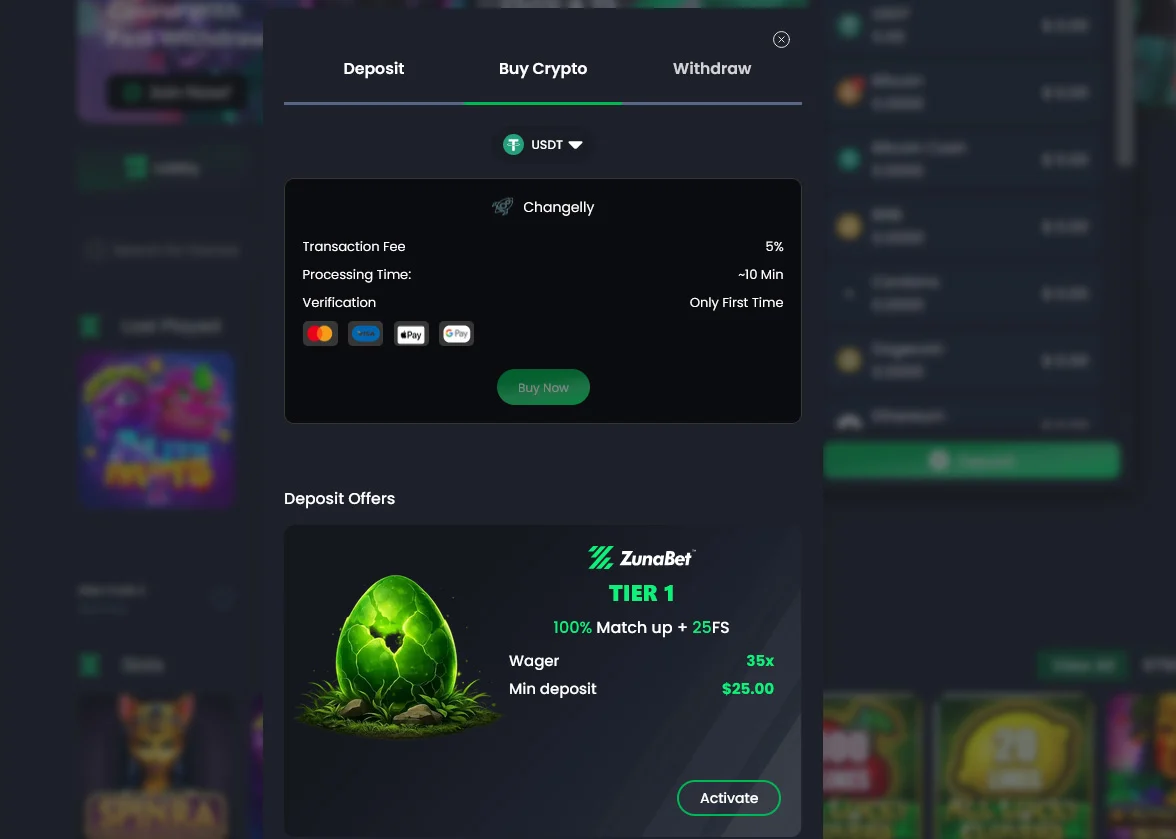
The no-fee policy is equally straightforward. ZunaBet does not charge processing fees on deposits or withdrawals. The player pays whatever the network fee is for the transaction they are sending — that is standard across all crypto transactions — and nothing on top of that. What the player withdraws is what arrives in their wallet.
The practical result is that players using ZunaBet with crypto experience online gambling the way digital payments are supposed to work. Fast, direct, low-cost, and without the institutional layers that fiat banking requires.
The Rest of the Platform
Payments are the foundation but they are not the whole picture. ZunaBet pairs its crypto infrastructure with a platform built to the same scale.
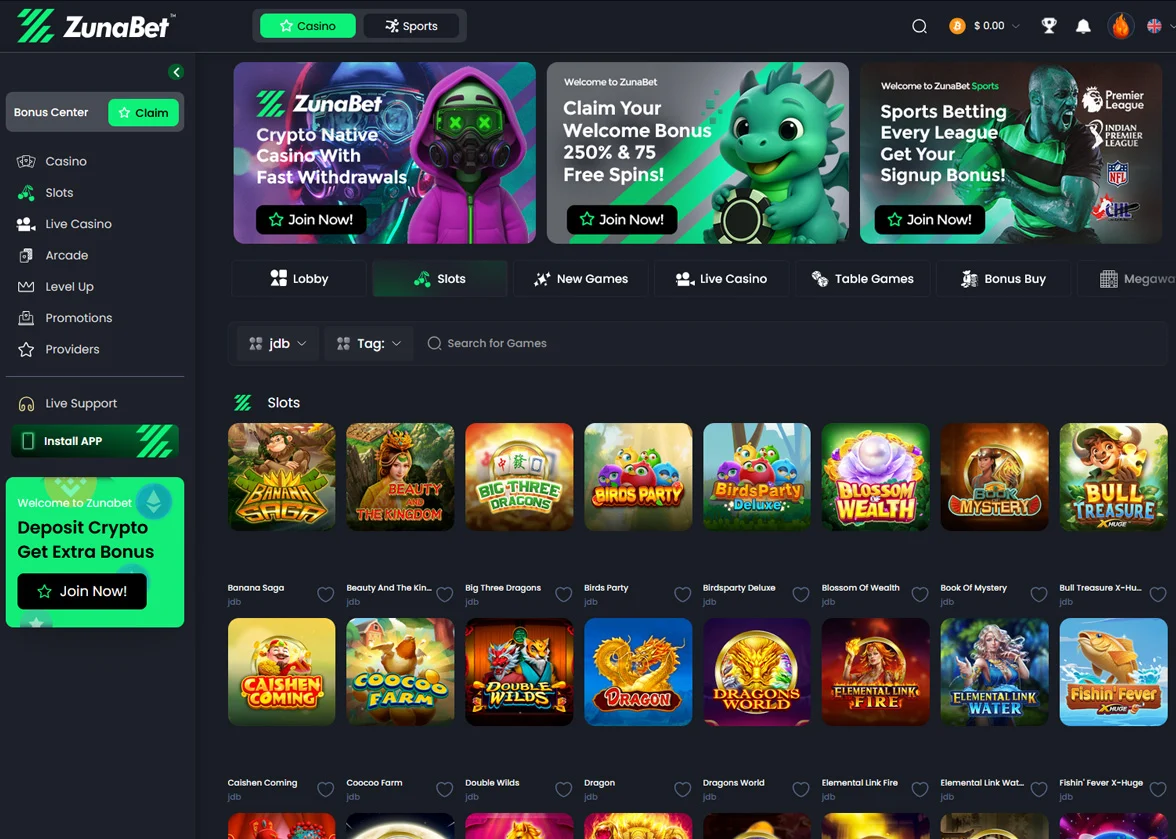
The game library carries 11,294 titles from 63 providers. Slots dominate as they do across the industry, but the live dealer section and RNG table games are substantial. Providers include Evolution, Pragmatic Play, Hacksaw Gaming, Yggdrasil, and BGaming. Sixty-plus providers means the library has genuine depth and variety rather than volume for its own sake.
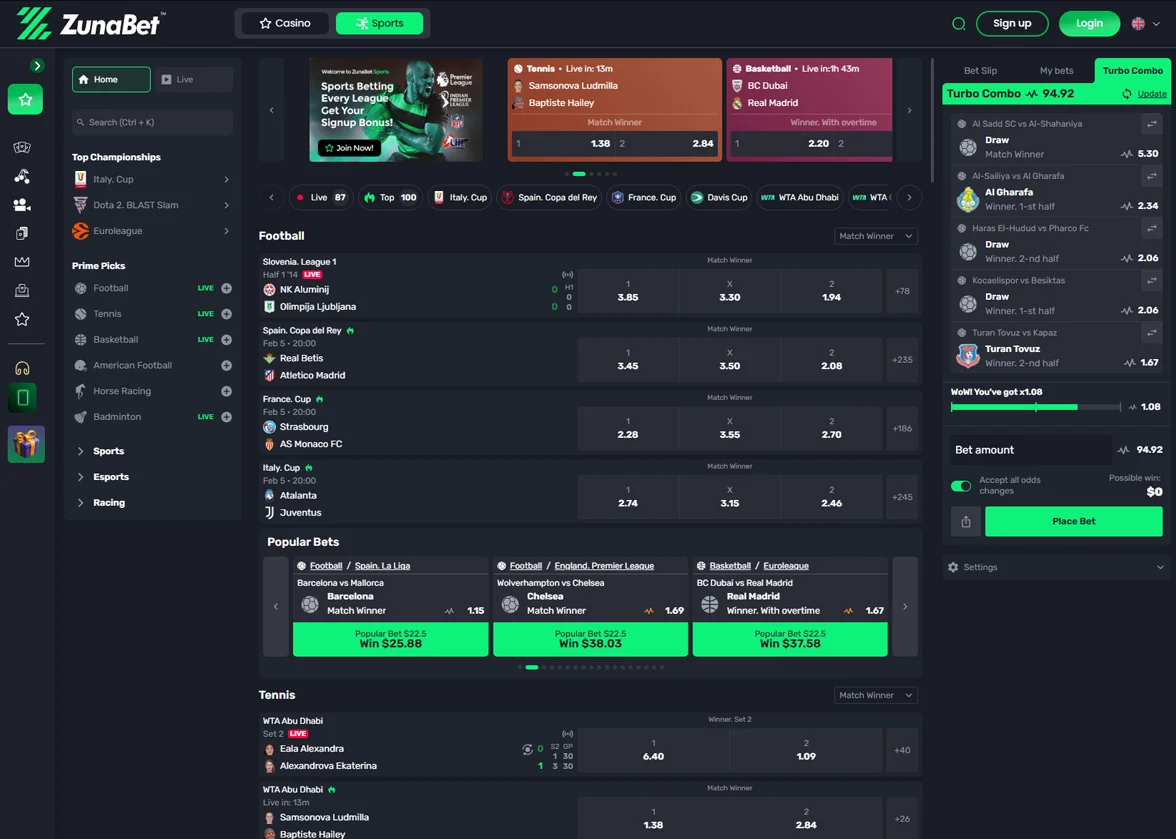
The sportsbook covers major global sports — football, basketball, tennis, NHL — alongside a full esports section including CS2, Dota 2, League of Legends, and Valorant. Virtual sports and combat sports round out the offering. It is a complete sportsbook sitting alongside the casino, not a token addition.
Apps are available on iOS, Android, Windows, and MacOS. Live chat support runs 24 hours a day. The platform uses modern HTML5 technology with a dark-themed interface and fast load times across devices.
The Welcome Bonus
New players receive a bonus across three deposits totalling up to $5,000 plus 75 free spins. The first deposit is matched 100% up to $2,000 with 25 free spins. The second is matched 50% up to $1,500 with 25 spins. The third is matched 100% up to $1,500 with 25 spins.
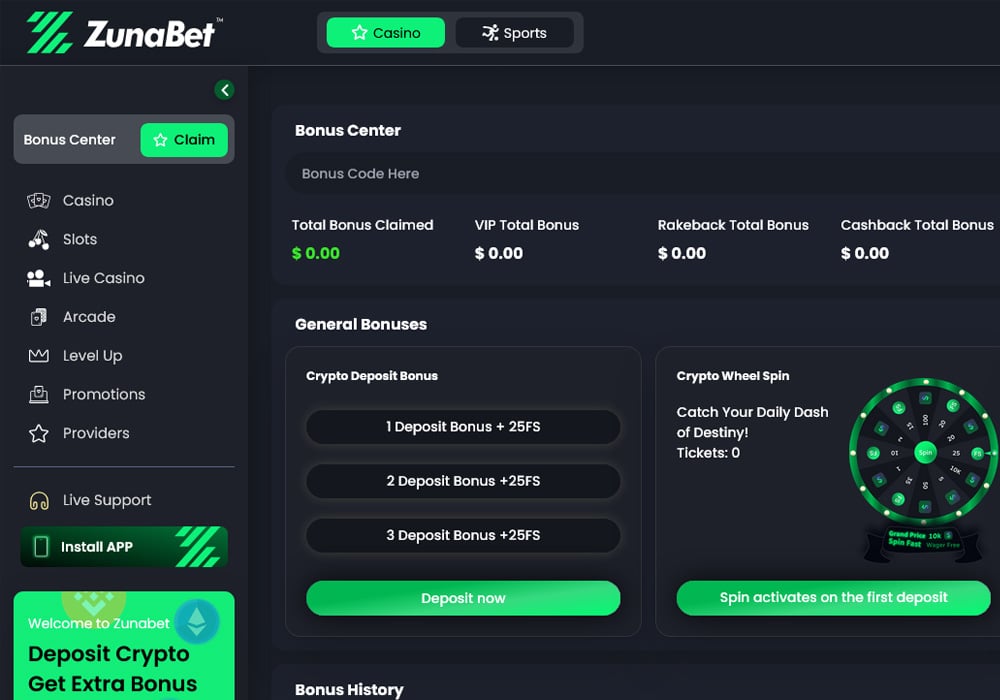
The structure spreads value across the early period of play rather than concentrating it in a single deposit. For players genuinely evaluating the platform it provides meaningful runway before the promotional period ends.
The Loyalty Program
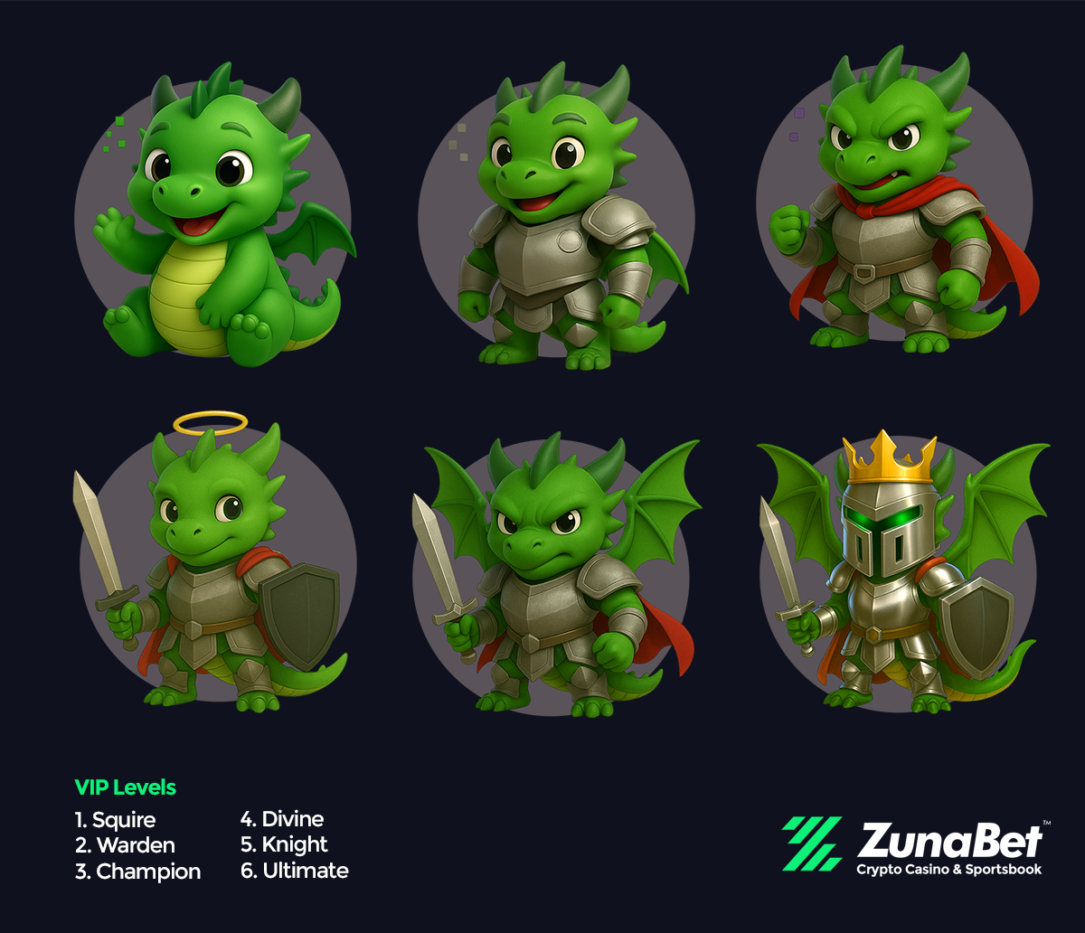
ZunaBet’s loyalty system operates on a rakeback model across six tiers — Squire, Warden, Champion, Divine, Knight, and Ultimate — built around a gamified dragon evolution theme with a mascot called Zuno.
Rakeback rates run from 1% at Squire up to 20% at Ultimate. These are direct financial returns on activity. No points to accumulate, no conversion rates to calculate, no redemption process to navigate. A player at the top tier gets a fifth of their activity value returned in straightforward terms.
The combination of a crypto-native payment system and a transparent rakeback loyalty program creates a platform where players know exactly what they are paying, exactly what they are getting back, and exactly how quickly their money moves. That clarity is not common in the industry. It is increasingly what players are looking for.
The Bigger Point
Crypto payments are not a gimmick or a marketing angle. For the players who use them, they solve real problems that fiat banking has never fully addressed — speed, fees, geographic access, and flexibility. The platforms that treat crypto as a core part of their infrastructure rather than a secondary option are the ones that will serve those players properly.
ZunaBet launched in 2026 with that infrastructure already in place. It is a new platform still building its track record, and that is worth acknowledging plainly. But for players whose primary frustration with traditional casinos is on the payment side — and there are a lot of them — it is a platform that has already answered the question they were asking.
