

Ask a regular online casino player what their loyalty program is actually worth and most of them cannot tell you. They know they have points. They know the points convert to something. They have a vague sense that playing more leads to better rewards somewhere down the line. But the specific value — what they get back per dollar spent, in terms they can calculate without reading a help page — is rarely something they can state with confidence.
That opacity is not accidental. Points systems are deliberately complex. The conversion rates vary by game. The redemption options carry different values. The tier thresholds are set at levels that keep most players perpetually climbing without quite arriving. The result is a loyalty program that feels rewarding in theory and delivers less than expected in practice.
ZunaBet launched in 2026 with a loyalty program built on a different principle entirely. Direct rakeback across six tiers, stated as a clear percentage, applying to all activity on the platform. No points. No conversion tables. No wondering whether you are getting fair value. This article looks at why that difference matters and what ZunaBet’s program actually delivers.
The Problem With Points
Points-based loyalty programs became the industry standard because they work well for the operator. They create the impression of value without committing to a specific return. A player earning points feels rewarded. Whether the points translate to meaningful value depends on factors the player rarely controls — redemption rates, tier requirements, expiry conditions, and game contribution percentages that vary widely across the library.
The major platforms have refined this model over years. DraftKings Dynasty Rewards, Caesars Rewards, BetMGM’s loyalty tier system, and FanDuel’s equivalent all operate on variations of the same structure. Points accumulate through play. Points redeem for free play credits, physical rewards, or in Caesars’ case, hotel stays and dining credits. The non-gambling redemption options have genuine value for certain players — particularly those who use Caesars properties regularly. For players whose primary interest is online gambling rather than hospitality perks, the value is less clear.

The specific frustration that drives players away from points systems tends to be the calculation problem. A player on a traditional platform who wants to know what their loyalty is worth has to find the points-per-dollar rate for the game they are playing, the conversion rate from points to their preferred redemption option, and then work out whether the result is meaningful at their volume of play. Most players do not do this calculation. They play, they accumulate, and they occasionally redeem something without being sure whether they received fair value.
Rakeback removes that calculation entirely.
What Rakeback Actually Is
Rakeback is a direct percentage return on gambling activity. The player bets, wins or loses, and receives a set percentage of their total wagered amount or net losses back as real value. The percentage is fixed at their tier level. The return applies regardless of which game they were playing. There is no conversion, no redemption process, and no ambiguity about what they are receiving.
The term comes from poker, where the rake — the house’s cut of each pot — was returned to regular players as an incentive to keep playing. Online casinos adapted the concept into a broader loyalty mechanism. In the crypto casino space it has become the preferred loyalty model because it matches what crypto-comfortable players expect from digital services — transparency, directness, and value they can calculate themselves.
A player on a 10% rakeback program who puts $1,000 through the platform in a month receives $100 back. A player on a 20% program receives $200. The maths takes seconds. The value is unambiguous. There is no hoping the points converted at a reasonable rate or wondering whether the free play credit was worth claiming.
ZunaBet’s Dragon Evolution Loyalty System
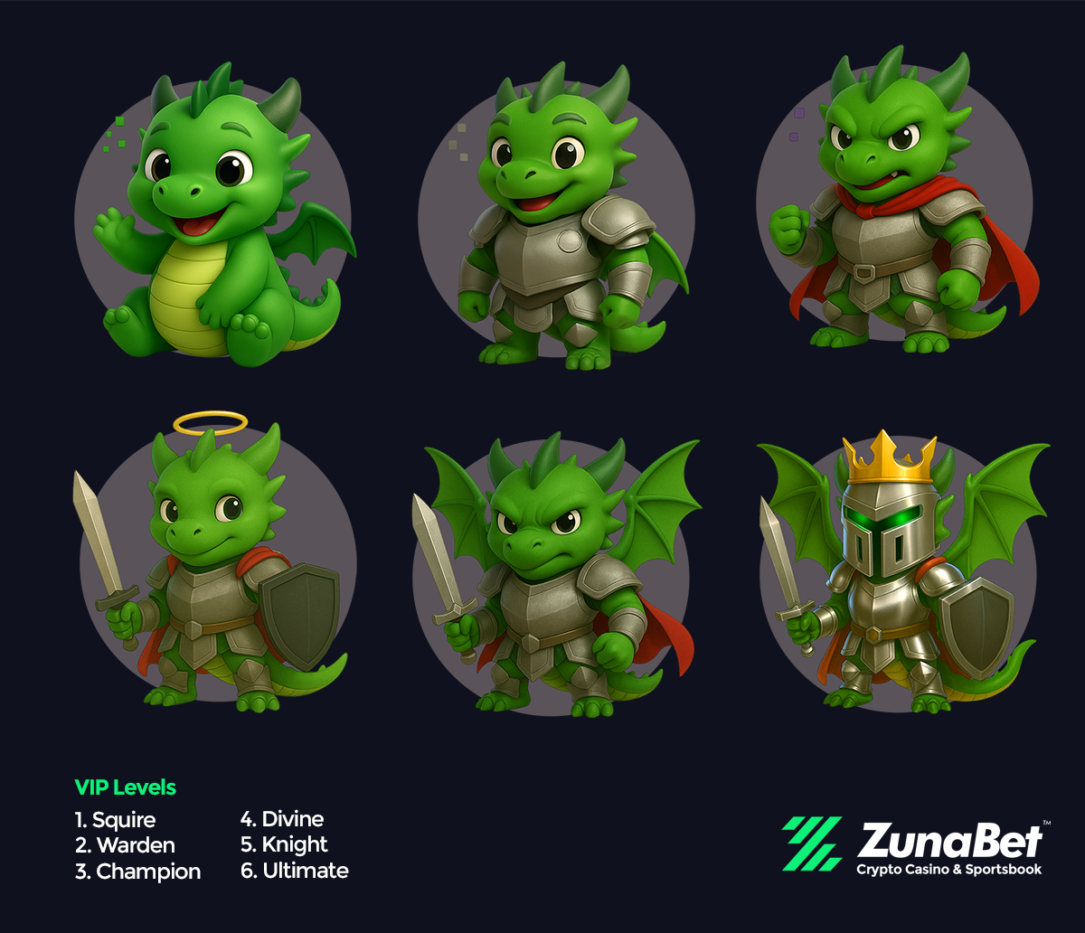
ZunaBet’s loyalty program is built around a dragon evolution theme with six tiers and a gamified mascot called Zuno. The visual identity gives it personality — players progress through dragon tiers rather than climbing a generic numbered league — but the substance is in the rakeback rates each tier delivers.
Squire is the entry tier at 1% rakeback. Warden follows at 2%. Champion sits at 4%. Divine reaches 5%. Knight hits 10%. Ultimate delivers 20%. Every tier above the first represents a meaningful step up in return, and the jump from Knight to Ultimate — from 10% to 20% — is significant for players who reach that level.
The rates apply across activity on the platform. It does not matter whether a player is in the slots section, at a live dealer table, or placing bets on the sportsbook. The rakeback applies to what they put in, wherever they put it. That universality is part of what makes it genuinely useful rather than a loyalty program that rewards one type of play and ignores another.
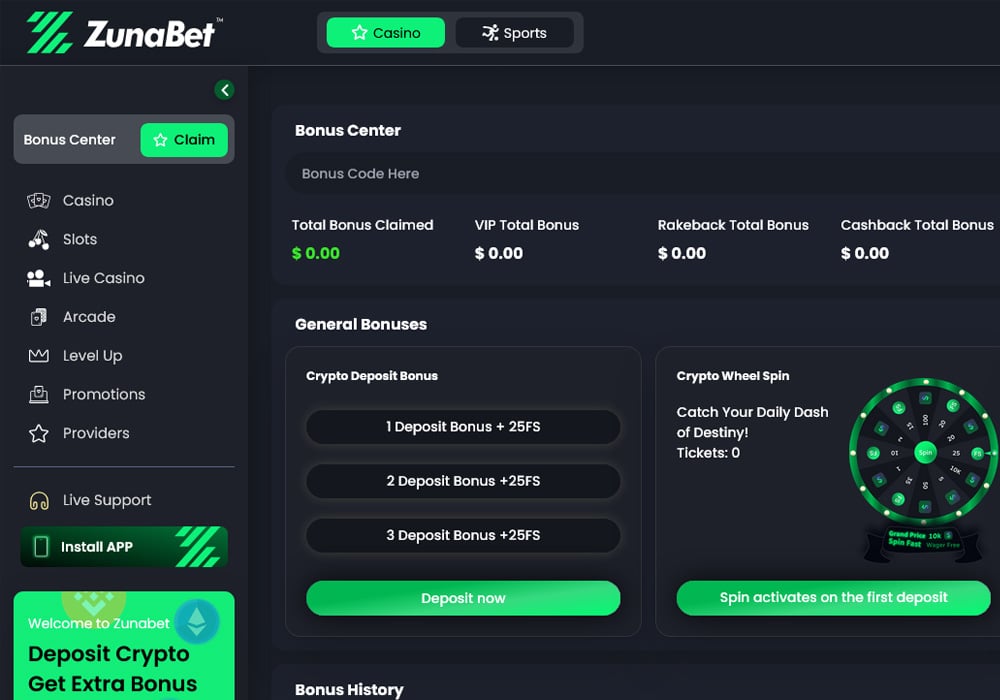
Additional benefits build on the core rakeback structure rather than replacing it. Higher tiers unlock up to 1,000 free spins, VIP club access, and double wheel spins. These are concrete additions on top of a loyalty foundation that already delivers direct financial value. For players who reach the upper tiers, the combination of 20% rakeback and escalating additional benefits represents one of the more generous loyalty structures currently available in the crypto casino space.
How It Compares in Practice
Put ZunaBet’s loyalty program alongside a traditional points system and the practical difference becomes clear through a simple example.
A player putting $500 per week through a platform — $2,000 per month — on ZunaBet’s Champion tier receives 4% rakeback. That is $80 per month returned directly, every month, without any redemption process. As they progress to Knight, the return on the same volume becomes $200 per month. At Ultimate it reaches $400 per month.
The same player on a traditional points platform earns points at a rate that varies by game, converts those points at a rate that varies by redemption option, and receives something — free play credits, perhaps — that has a notional value but cannot be withdrawn as cash. The actual financial return is difficult to calculate and typically lower than rakeback at equivalent volumes.
For casual players the difference is less significant. For regular players who put consistent volume through a platform, the gap between a transparent rakeback system and a points system that obscures its return rate is material. It is the difference between knowing what your loyalty is worth and hoping it is worth something.
The Platform Behind the Program
A loyalty program is only as useful as the platform it sits on. ZunaBet is owned by Strathvale Group Ltd, operates under an Anjouan gaming license, and is registered in Belize. It launched in 2026 with a team carrying over 20 years of combined industry experience.
The game library carries 11,294 titles from 63 providers — slots, live dealer games, and RNG table games from Evolution, Pragmatic Play, Hacksaw Gaming, Yggdrasil, BGaming, and others. The sportsbook covers major global sports alongside esports — CS2, Dota 2, League of Legends, Valorant — plus virtual sports and combat sports. Payment support covers 20-plus cryptocurrencies with no processing fees and fast withdrawals. Apps run on iOS, Android, Windows, and MacOS with 24/7 live chat support.
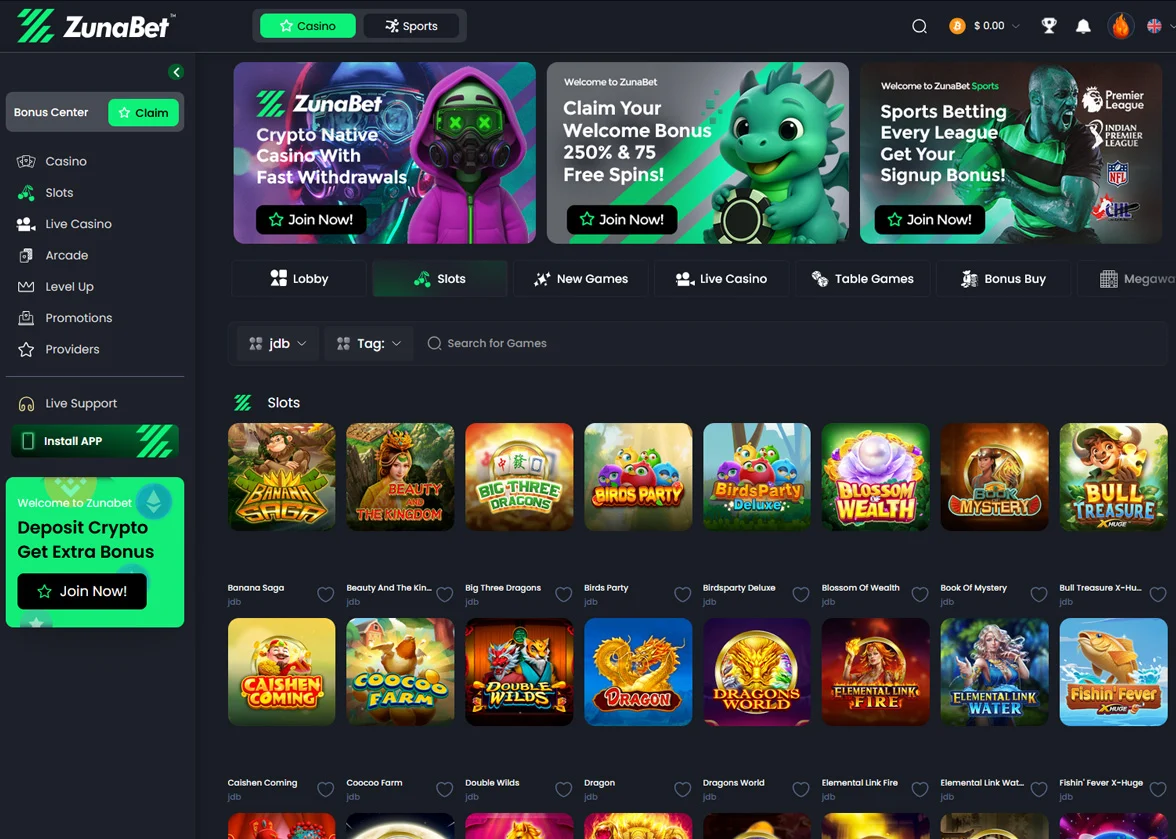
New players receive a welcome bonus across three deposits totalling up to $5,000 plus 75 free spins — 100% up to $2,000 with 25 spins on the first deposit, 50% up to $1,500 with 25 spins on the second, and 100% up to $1,500 with 25 spins on the third.
The platform is built to support regular, sustained play — which is exactly the type of play that makes a rakeback loyalty program most valuable. A generous loyalty program on a platform with a thin game library or unreliable payments is of limited use. ZunaBet pairs the loyalty structure with a complete platform that gives players genuine reasons to stay.
Why Transparency in Loyalty Programs Matters More Than It Used To
The shift toward rakeback and away from points is part of a broader change in what players expect from digital services. Transparency has become a baseline expectation rather than a differentiator. Players who use crypto already operate in an environment where transaction values are visible, fees are stated upfront, and nothing is hidden behind institutional processes. They bring the same expectation to loyalty programs.
A loyalty program that requires a calculator and a help page to evaluate is out of step with that expectation. A program that states a percentage and applies it consistently is not. ZunaBet’s dragon evolution system is built on the latter principle — and for players who have grown tired of points systems that sound better than they are, that directness is a meaningful reason to pay attention.
ZunaBet is a new platform launched in 2026 and its long-term track record is still being established. That is worth stating plainly. But what it launched with — a loyalty program built on transparency, directness, and rates that deliver real value at higher tiers — reflects a platform that has thought carefully about what regular players actually want. For those players, it makes a strong case.
