

The rivalry between FanDuel and BetMGM gets a lot of coverage. Both platforms spend heavily on marketing, both operate in multiple regulated US states, and both are genuinely competitive products within their lane. But that lane is a fiat one — built on bank accounts, card payments, and traditional financial infrastructure. For crypto bettors in 2026, the more interesting conversation is happening somewhere else entirely.
FanDuel: The Sportsbook Benchmark That Crypto Can’t Use
FanDuel earned its position at the top of the US regulated sportsbook market. The product is tight — fast odds, solid in-play markets, a dependable app, and coverage of every major US sport. For regulated sports betting, it sets the standard other platforms are measured against.
The casino has grown into a credible secondary offering. Slots, live dealer tables, and RNG games are available in licensed states with a user experience that feels consistent and well-built throughout.
None of that changes the fundamental issue for crypto players. FanDuel’s payment infrastructure is entirely fiat. Cards, bank transfers, PayPal — those are the options. There is no Bitcoin deposit, no USDT withdrawal, no on-chain pathway of any kind. For a player who operates out of a self-custody wallet, that’s not a minor inconvenience. It’s a complete incompatibility.
FanDuel Rewards is a points accumulation system. Play generates points, points convert to site credit, and the actual return percentage is kept deliberately vague. It works as a retention mechanism but offers no transparency about what players are genuinely getting back relative to their activity.
BetMGM: Casino Depth, Same Fiat Limitations
BetMGM’s identity is built around its casino product and the MGM brand gives it real weight. Live dealer content is among the strongest in the licensed US market, the slot catalogue is extensive, and the overall platform feels premium in a way that reflects the land-based casino heritage behind it.
The sportsbook covers the main US leagues competently. It’s not where BetMGM makes its name but it performs reliably and doesn’t detract from the overall product.
MGM Rewards has genuine differentiation for a specific player type — those who engage with MGM resort properties and want online activity to feed into real-world benefits. For that audience it’s a meaningful loyalty feature. For the broader online-only player base it’s a well-presented points program without much that stands out.
Crypto is not a factor at BetMGM. The payment experience is fiat-dependent in exactly the same way FanDuel’s is. Traditional banking timelines, standard identity verification tied to financial institutions, and no support for digital assets at the infrastructure level. The two platforms differ in product emphasis but share the same fundamental limitations for anyone operating on-chain.
Why Licensed US Operators Can’t Bridge This Gap
The absence of crypto at FanDuel and BetMGM isn’t an oversight. It’s a consequence of operating as licensed US gambling platforms. The regulatory requirements — KYC processes tied to traditional financial systems, banking partner relationships, state-level compliance obligations — make meaningful crypto integration practically impossible within that framework.

These platforms were designed for the existing financial system and they work well within it. The issue is that a growing segment of bettors has moved outside that system. Self-custody wallets, stablecoins across multiple chains, on-chain settlement speeds — these are normal for crypto-native players, and no amount of product polish at FanDuel or BetMGM addresses that mismatch.
ZunaBet: Purpose-Built for the On-Chain Bettor
ZunaBet launched in 2026 under Strathvale Group Ltd with an Anjouan gaming license and a founding team carrying over 20 years of industry experience. The platform didn’t arrive feeling experimental. It launched as a complete product with a clear focus — serve the crypto-native bettor properly.
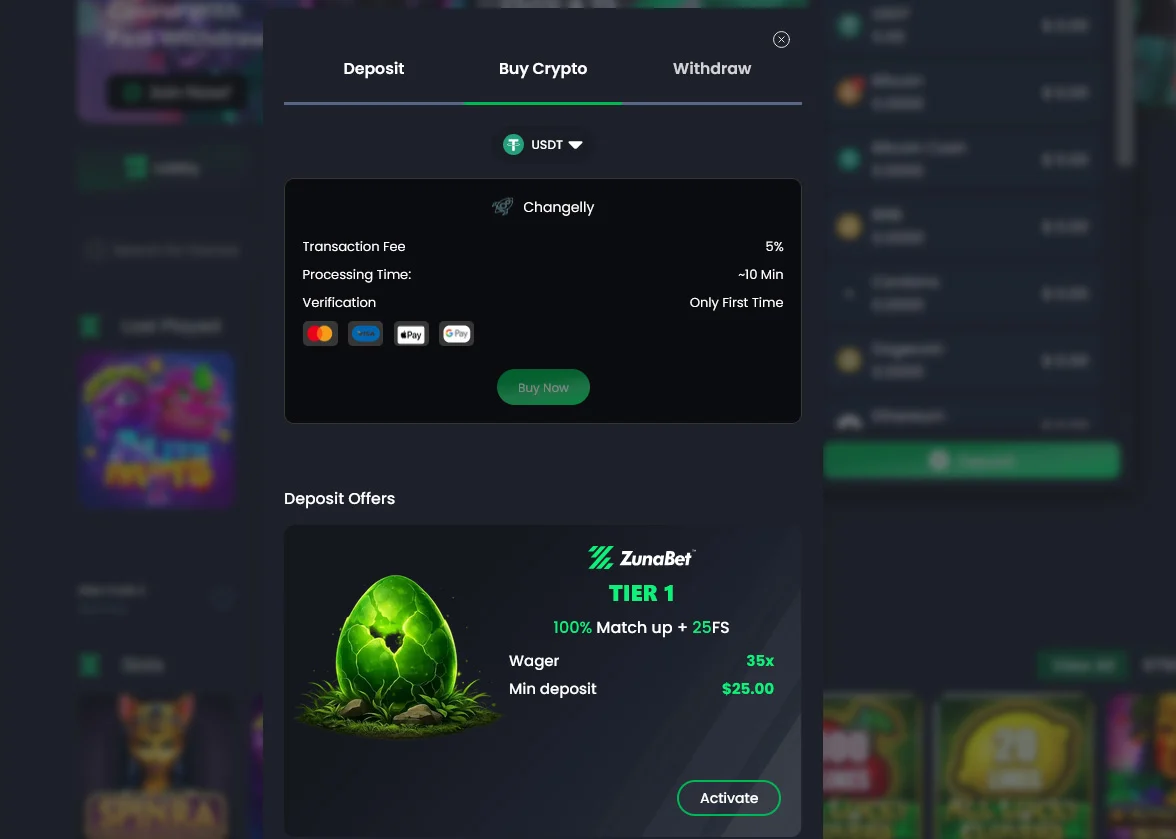
Crypto support goes well beyond token acceptance. Over 20 digital assets are live — BTC, ETH, SOL, USDT across multiple chains, XRP, ADA, DOGE, and others. No platform processing fees. Withdrawals process at the speed crypto is supposed to move at. The entire payment layer is built around digital assets as the primary method, not a secondary option accommodated reluctantly.
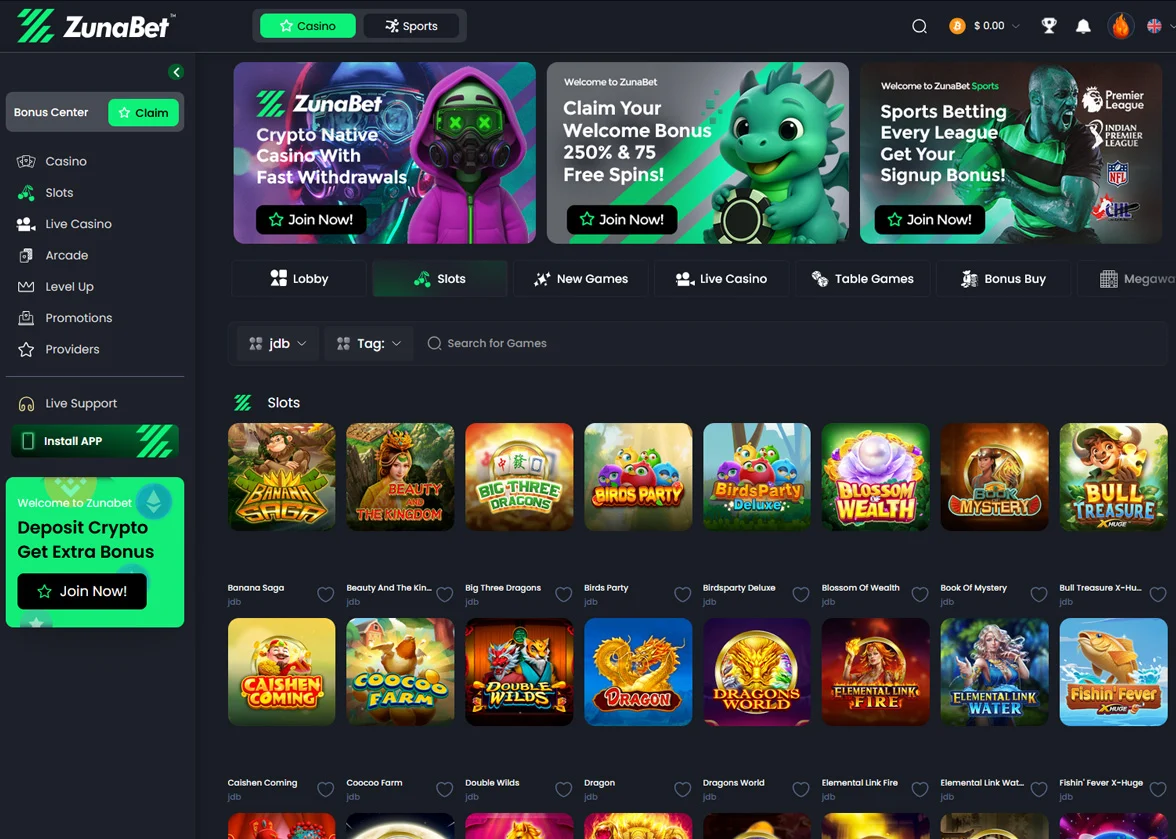
The game library reaches over 11,000 titles from more than 60 providers. Evolution, Pragmatic Play, Hacksaw Gaming, BGaming, and Yggdrasil are among those supplying a catalogue that spans slots, live dealer games, and RNG table content. The scale of this library is notable — most crypto casinos operate with a fraction of it, and ZunaBet’s count sits comfortably among the larger libraries in the broader market.
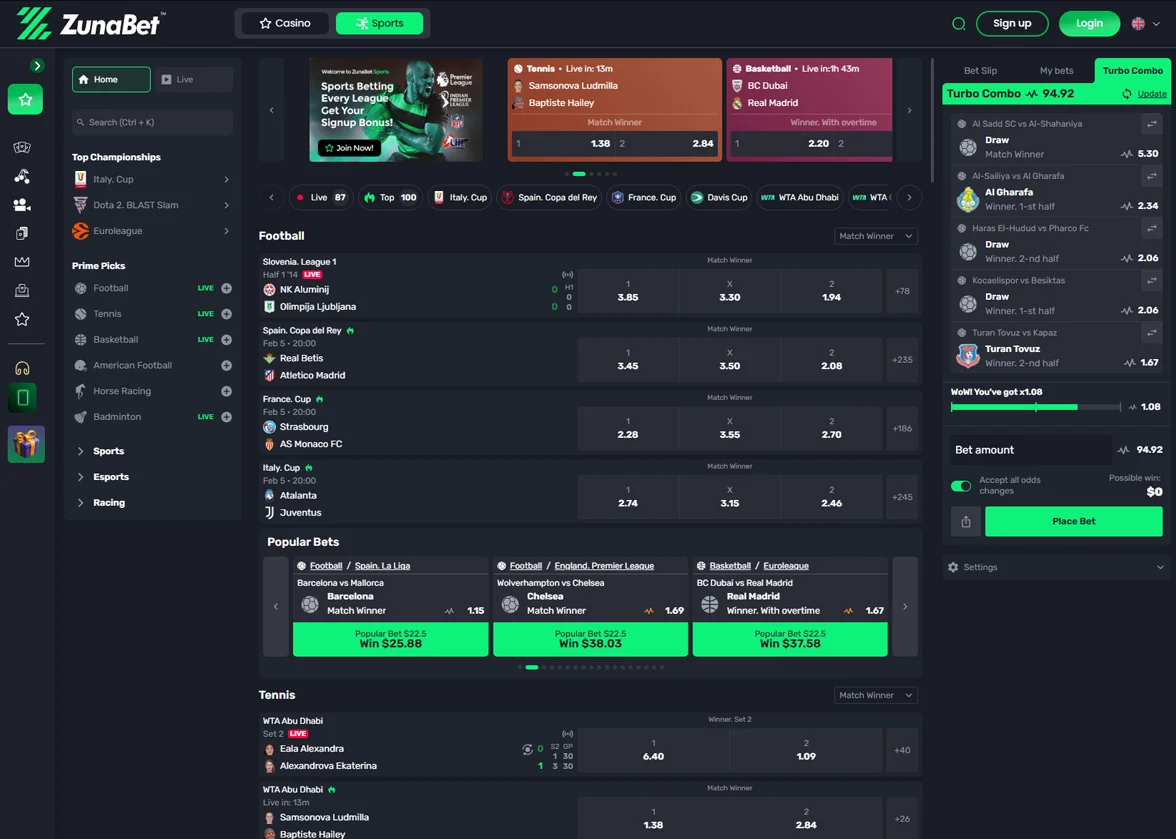
The sportsbook is a full product, not a placeholder. All major global sports and US leagues are covered alongside a proper esports section — CS2, Dota 2, League of Legends, and Valorant — plus virtual sports and combat sports. Casino, sportsbook, and esports under one roof with crypto payments throughout.
Welcome Package: $5,000 and 75 Spins Across Three Deposits
ZunaBet’s welcome offer is structured across the first three deposits for a combined total of up to $5,000 plus 75 free spins. Deposit one earns a 100% match up to $2,000 and 25 spins. Deposit two earns 50% up to $1,500 and 25 spins. Deposit three earns 100% up to $1,500 and the remaining 25 spins.
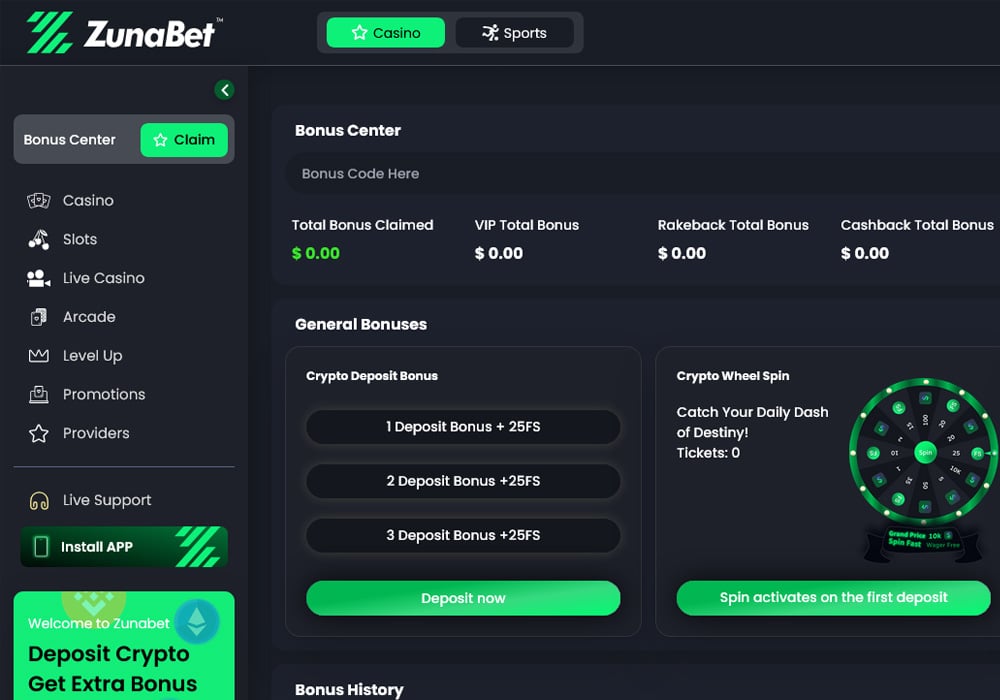
Spreading the package across multiple deposits rather than concentrating it in a single front-loaded bonus is a practical decision. It extends meaningful value over an onboarding period and suits players who deposit regularly rather than those looking to extract a one-time match and move on. For crypto players making incremental deposits, it fits the natural rhythm of how they use a platform.
Rakeback Changes the Loyalty Equation Entirely
Points programs obscure value by design. The platform controls the conversion rate, the actual return percentage is rarely published clearly, and players are left guessing what their activity is genuinely worth in return. That’s true of FanDuel Rewards and MGM Rewards equally.
ZunaBet’s Zuno loyalty program operates on rakeback — a direct, stated percentage return on play across six tiers. Squire delivers 1%. Warden delivers 2%. Champion 4%. Divine 5%. Knight 10%. Ultimate delivers 20% rakeback. Each number is explicit. There’s no conversion rate to reverse-engineer and no ambiguity about what a player gets back as they move up through the tiers.
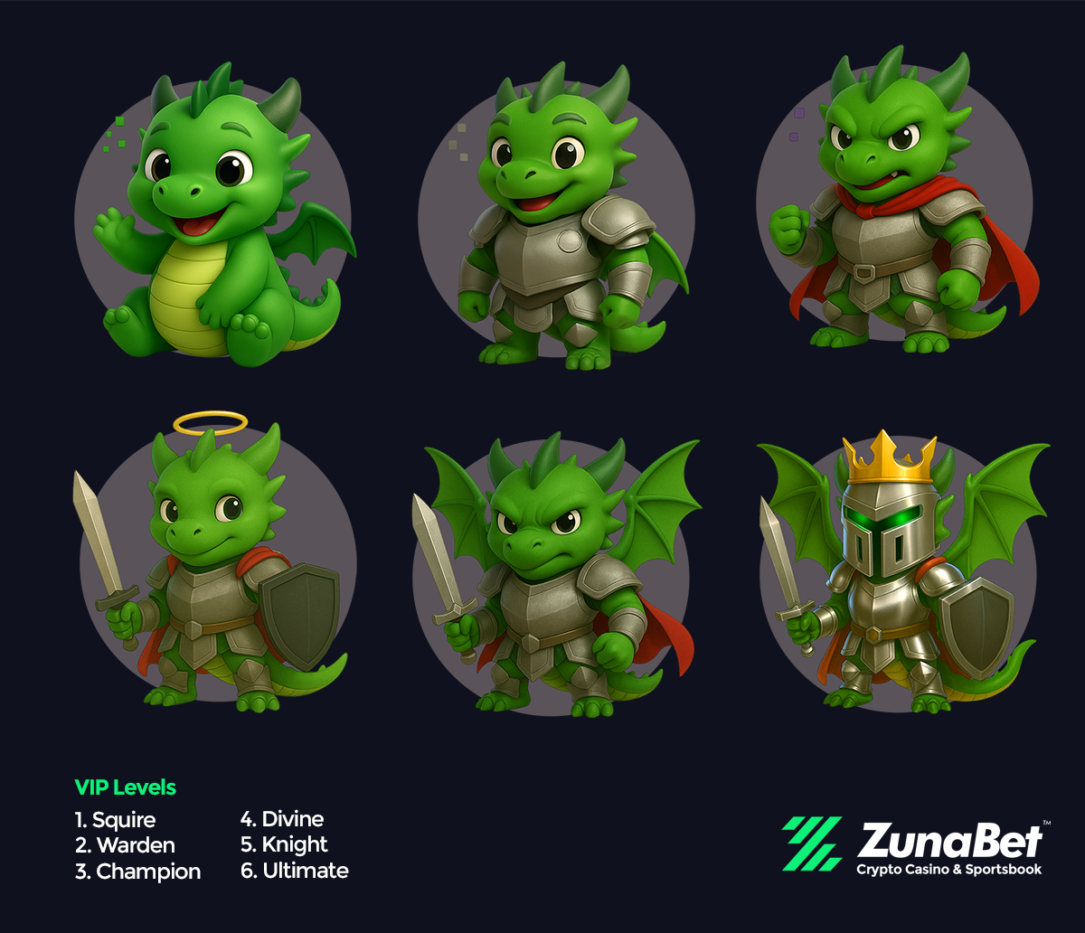
Tier progression also unlocks up to 1,000 free spins, VIP club access, double wheel spins, and a gamified experience built around the platform’s dragon mascot Zuno. The combination of transparent rakeback and tangible tier rewards makes this a loyalty structure that high-volume crypto players can actually calculate and plan around — which is exactly what a points program never allows.
The Direction of Travel Is Clear
Traditional fiat-first platforms and crypto-native ones are not converging. The regulatory and infrastructure constraints that keep FanDuel and BetMGM in the fiat lane are not going away. Meanwhile, the number of players whose financial default is on-chain continues to grow. The gap between what those players need and what licensed US operators can offer is widening, not narrowing.
ZunaBet is positioned on the right side of that gap. It was built there intentionally, and the product reflects that clarity of purpose from payments through to loyalty.
The Call
FanDuel is the right call for US regulated sports betting if fiat is your world. BetMGM is the right call for licensed casino play with the added dimension of MGM resort integration. Both earn their reputations within the framework they operate in.
Outside that framework — in the on-chain world where crypto players actually live — neither platform competes. ZunaBet does. Launched in 2026 with 20+ cryptocurrencies, 11,000+ games, a complete sportsbook including esports, a $5,000 multi-deposit welcome bonus, and a rakeback program that reaches 20% at the top tier, it’s the platform built for the bettor the traditional names were never going to serve.
